
Have you ever applied for an IPO and wondered:
“When will I know whether I got the shares?”
“Why didn’t I receive an allotment even after applying?”
“How does IPO allotment actually work?”
You’re not alone.
Many first-time investors believe that simply applying for an IPO guarantees they’ll receive shares. In reality, IPO allotment follows a systematic process governed by stock exchange regulations.
In this beginner-friendly guide, you’ll learn exactly how the IPO allotment process works, how shares are allocated, why some investors receive allotments while others don’t, and how to check your allotment status.
What Is IPO Allotment?
IPO allotment is the process of distributing shares to investors after the IPO subscription period closes.
If demand is lower than or equal to the available shares, most eligible investors receive the shares they applied for.
However, when demand exceeds supply (called oversubscription), not everyone receives shares. A computerized allotment process determines who gets the allotment.
Why Is IPO Allotment Necessary?
Every IPO has a limited number of shares available.
Sometimes thousands or even millions of investors apply for those shares.
The allotment process ensures that shares are distributed fairly according to SEBI regulations.
Think of it like booking tickets for a popular concert.
If only 10,000 seats are available but 100,000 people apply, everyone cannot receive a ticket.
The same principle applies to IPOs.
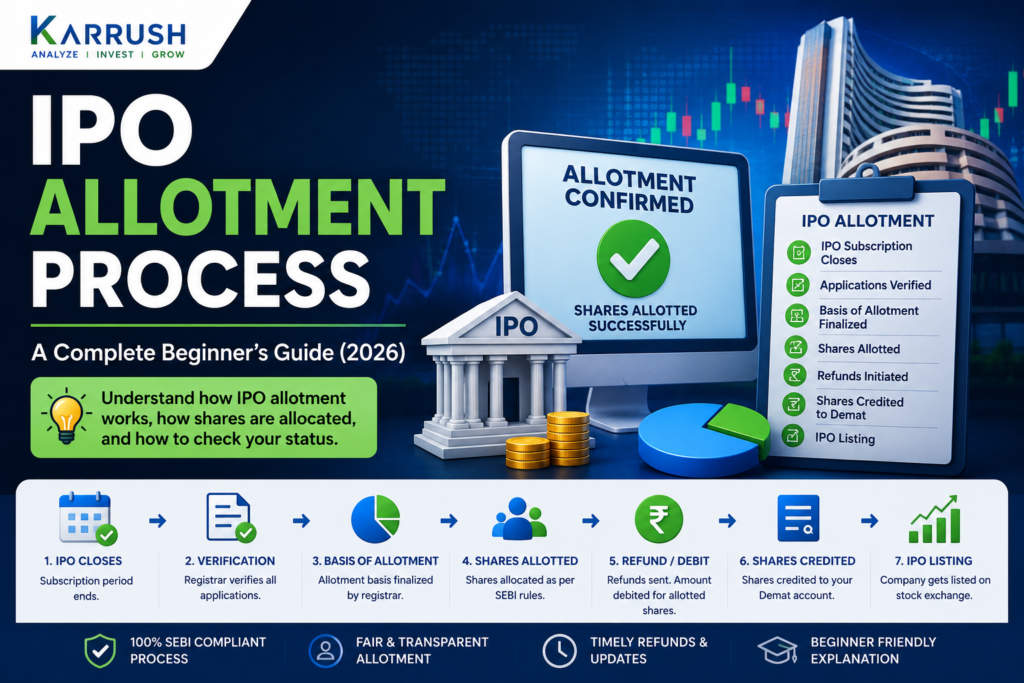
Step-by-Step IPO Allotment Process
Step 1: IPO Subscription Closes
Investors submit applications during the IPO period.
After the final day, no more applications are accepted.
Step 2: Registrar Collects Applications
The IPO registrar verifies every application.
They check:
- PAN details
- Demat account
- UPI mandate
- Bank account
- Duplicate applications
- Technical errors
Invalid applications are rejected.
Step 3: Calculate Total Demand
The registrar counts how many investors applied.
This determines whether the IPO is:
- Undersubscribed
- Fully subscribed
- Oversubscribed
Step 4: Share Allotment Begins
If the IPO is undersubscribed, most eligible applicants receive shares.
If oversubscribed, the registrar follows SEBI’s allotment rules.
Retail investors generally receive allotments through a computerized lottery system when demand is very high.
Step 5: Final Allotment Is Approved
The stock exchange approves the final allotment list.
Step 6: Refunds and UPI Mandate Release
If you do not receive shares:
- Your blocked amount is released.
- No money is deducted.
If you receive shares:
The corresponding amount is debited from your account.
Step 7: Shares Credited to Demat Account
The allotted shares are transferred to your Demat account.
Step 8: IPO Listing
The company gets listed on NSE or BSE.
Investors can then buy or sell shares in the secondary market.
IPO Allotment Timeline
| IPO Opens | Day 1 |
| IPO Closes | Day 3 |
| Basis of Allotment | 1–3 working days |
| Refunds / UPI Release | Same day or next day |
| Shares Credited | Before listing |
| IPO Listing | Usually within a week after closing |
What Happens If an IPO Is Oversubscribed?
Suppose a company offers:
1 lakh shares
But investors apply for:
20 lakh shares
This means the IPO is 20× oversubscribed.
Since there aren’t enough shares for everyone, the registrar uses SEBI-approved allotment rules.
Some investors receive shares, while others receive none.
How to Check IPO Allotment Status
You can check your allotment using:
- Registrar’s website
- BSE IPO Allotment page
- NSE IPO page
- Your broker app (Groww, Zerodha, Angel One, Dhan, etc.)
Usually you’ll need:
- PAN Number
- Application Number
- Demat Account Number
Karrush Insight
Many beginners think applying with a larger amount guarantees allotment.
This is not true for most retail IPOs.
Submitting multiple applications using the same PAN is also not allowed and may result in rejection.
Instead, always submit one valid application with accurate details before the IPO closes.
Common Reasons You May Not Receive an IPO Allotment
- IPO heavily oversubscribed
- Invalid PAN details
- Wrong Demat account
- UPI mandate not approved
- Duplicate applications
- Technical errors
Tips to Improve Your Chances
✅ Apply before the closing day.
✅ Approve the UPI mandate immediately.
✅ Double-check PAN and Demat details.
✅ Avoid submitting duplicate applications.
✅ Apply only after understanding the company’s fundamentals.
Frequently Asked Questions
Is IPO allotment random?
Retail allotment in highly oversubscribed IPOs is generally conducted using a computerized lottery process according to SEBI regulations.
Will my money be deducted immediately?
No.
The amount remains blocked until allotment is completed.
What happens if I don’t get shares?
Your blocked amount is released back to your bank account.
Can I apply multiple times?
No.
Multiple applications using the same PAN are generally rejected.
When are shares credited?
Usually one day before the IPO listing date.
Final Thoughts
IPO allotment is designed to distribute shares fairly among eligible investors.
Understanding how the allotment process works helps investors set realistic expectations and avoid common mistakes.
Always apply with correct details, approve your UPI mandate on time, and invest only after carefully evaluating the company, not just because an IPO is popular.