
Have you ever heard investors saying:
“I applied for the IPO through Zerodha.”
“Did you get the UPI mandate?”
“The IPO got subscribed 120 times!”
For many beginners, applying for an IPO may sound complicated. Terms like Demat Account, UPI Mandate, ASBA, Subscription Numbers, and Allotment can seem confusing at first.
The good news?
Applying for an IPO today is easier than ordering food online.
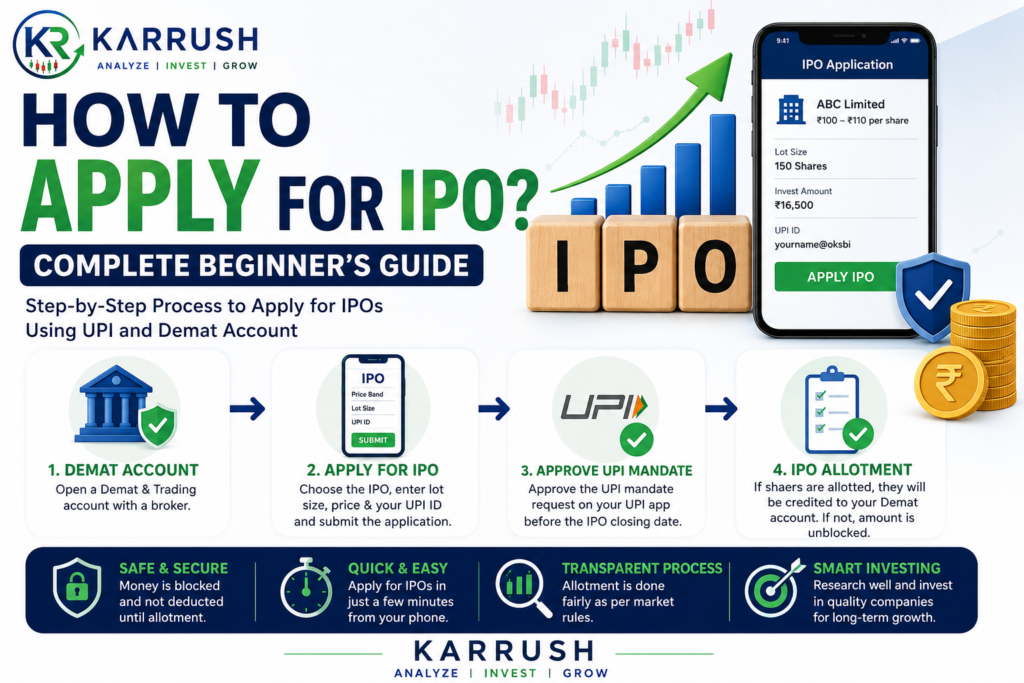
With a Demat account, a bank account, and a UPI app, you can apply for most IPOs within a few minutes.
In this guide, we’ll explain everything you need to know about IPO applications in simple language, including:
- What an IPO is
- Requirements to apply
- Step-by-step IPO application process
- Applying through brokers like Zerodha and Groww
- UPI mandate approval
- Common mistakes beginners make
- Tips to improve your IPO investing journey
Let’s begin.
What is an IPO?
IPO stands for Initial Public Offering.
When a private company decides to raise money from the public, it offers its shares for sale through an IPO.
After the IPO process is completed, the company’s shares get listed on stock exchanges such as NSE and BSE.
Simple Example
Imagine a company called ABC Technologies.
The company wants to expand its business and raise ₹1,000 crore.
Instead of taking loans, it decides to sell ownership shares to investors.
The company launches an IPO.
Investors apply for shares.
After listing, those shares start trading on stock exchanges.
This entire process is called an IPO.
Why Do Investors Apply for IPOs?
Most investors apply for IPOs because they hope to benefit from:
1. Listing Gains
The share may list above the issue price.
Example:
Issue Price = ₹100
Listing Price = ₹150
Profit = ₹50 per share
2. Long-Term Investment
Some investors buy IPOs to hold quality businesses for many years.
Examples include:
- Infosys
- TCS
- IRCTC
- DMart
Many IPO investors became long-term shareholders and created significant wealth.
3. Early Participation
An IPO allows investors to participate in a company before it becomes widely traded.
Requirements to Apply for an IPO
Before applying, ensure you have:
1. PAN Card
PAN is mandatory for IPO applications.
Without PAN, you cannot apply.
2. Demat Account
Shares allotted in an IPO are credited to your Demat account.
Popular brokers include:
- Zerodha
- Groww
- Angel One
- Upstox
- Dhan
3. Bank Account
A valid bank account is required because the application amount remains blocked until allotment.
4. UPI ID
Most retail IPO applications use UPI.
Examples:
- yourname@oksbi
- yourname@ybl
- yourname@okicici
What is ASBA?
ASBA stands for:
Application Supported by Blocked Amount
Under ASBA:
- Money stays in your bank account
- Amount gets blocked
- Money is debited only if shares are allotted
This system protects investors because funds remain under their control until allotment.
Step-by-Step IPO Application Process
Let’s understand the complete journey.
Step 1: Choose an IPO
Before applying, study the company carefully.
Check:
- Revenue growth
- Profitability
- Debt levels
- Industry prospects
- IPO valuation
Never apply simply because others are applying.
Step 2: Log Into Your Broker Account
Open your broker platform.
Examples:
- Zerodha Kite
- Groww
- Angel One
Navigate to the IPO section.
Step 3: Select the IPO
You’ll see:
- IPO name
- Price band
- Lot size
- Opening date
- Closing date
Choose the IPO you wish to apply for.
Step 4: Enter Quantity
IPOs are applied in lots.
Example:
Lot Size = 150 shares
Issue Price = ₹100
Investment Required:
150 × ₹100 = ₹15,000
You can apply for one lot or multiple lots depending on category limits.
Step 5: Enter UPI ID
Provide your UPI ID.
Example:
yourname@oksbi
Double-check before submitting.
Incorrect UPI IDs are one of the most common reasons for application failure.
Step 6: Submit Application
After submission:
Your application reaches the IPO system.
The next step is mandate approval.
Step 7: Approve UPI Mandate
You will receive a request on your UPI app.
Example:
Google Pay
PhonePe
BHIM
Paytm
Approve the mandate before the IPO closing deadline.
Without approval, your application becomes invalid.
Step 8: Wait for Allotment
After the IPO closes:
- Applications are verified
- Basis of allotment is finalized
- Shares are allocated
Step 9: Check Allotment Status
You can check:
- Registrar website
- Broker platform
- IPO allotment portal
If allotted:
Shares are credited to your Demat account.
If not allotted:
Blocked amount is released.
How to Apply for IPO Using Zerodha
Zerodha is one of India’s most popular brokers.
Steps
- Login to Zerodha Console
- Open IPO Section
- Select IPO
- Enter quantity
- Enter UPI ID
- Submit application
- Approve mandate
That’s it.
The entire process usually takes less than five minutes.
How to Apply for IPO Using Groww
Groww provides a simple IPO application process.
Steps
- Open Groww App
- Select IPO Section
- Choose IPO
- Enter lot quantity
- Enter UPI ID
- Submit application
- Approve mandate
Groww is particularly beginner-friendly because of its simple interface.
Example: Applying for an IPO
Let’s assume:
Issue Price = ₹100
Lot Size = 150 Shares
Investment Required:
150 × ₹100 = ₹15,000
You submit the application.
The bank blocks ₹15,000.
Now two outcomes are possible.
Scenario 1: Shares Allotted
Shares credited.
₹15,000 debited.
Scenario 2: Shares Not Allotted
Shares not received.
₹15,000 unblocked.
Money returns automatically.
Understanding IPO Categories
Different investors apply under different categories.
Retail Investors
Investment up to ₹2 lakh.
Most individual investors belong here.
HNI Investors
Investment above ₹2 lakh.
Generally larger investors.
Institutional Investors
Mutual funds, banks, insurance companies, and large institutions.
Common Mistakes Investors Make
Many beginners make avoidable errors.
Let’s look at them.
1. Applying Without Research
Many people blindly follow social media hype.
This can be dangerous.
Always study:
- Business model
- Profitability
- Debt
- Growth prospects
2. Entering Wrong UPI ID
A small mistake can invalidate your application.
Always verify carefully.
3. Forgetting UPI Approval
Many investors submit applications but forget mandate approval.
Result:
Application becomes invalid.
4. Applying at the Last Minute
Technical issues may occur.
Apply early whenever possible.
5. Chasing Every IPO
Not every IPO is good.
Some companies have:
- Weak profits
- High debt
- Expensive valuations
Selectivity matters.
Can IPO Applications Guarantee Profit?
No.
This is one of the biggest misconceptions.
Many investors assume:
“IPO means guaranteed listing gains.”
That is incorrect.
Some IPOs list below issue price.
Example:
Issue Price = ₹100
Listing Price = ₹85
Loss = ₹15 per share
IPO investing carries risk like any other investment.
How to Evaluate an IPO Before Applying
Consider these factors.
Revenue Growth
Is revenue increasing consistently?
Growing businesses often attract stronger investor interest.
Profitability
Check whether the company earns profits.
Profitable businesses generally have stronger fundamentals.
Debt Levels
Excessive debt increases financial risk.
Lower debt is usually preferable.
Industry Potential
Is the industry growing?
A strong industry can support long-term business growth.
Valuation
Even a good company can become a poor investment if valuation is too expensive.
Always compare valuation with industry peers.
Should Beginners Apply for Every IPO?
No.
Quality matters more than quantity.
A disciplined investor may skip many IPOs and apply only for the strongest opportunities.
Sometimes the best investment decision is saying:
“No, this IPO doesn’t meet my criteria.”
Karrush Insight
Many beginners focus only on one question:
“What is the GMP today?”
While GMP can provide clues about market sentiment, it should never be the sole reason for applying.
A smart IPO investor evaluates:
✅ Business quality
✅ Revenue growth
✅ Profitability
✅ Debt levels
✅ Valuation
✅ Industry prospects
✅ Subscription trends
✅ GMP sentiment
Think of GMP as a weather forecast.
A weather forecast can indicate what might happen, but it cannot guarantee the outcome.
Similarly, a high GMP may indicate positive sentiment, but listing gains are never guaranteed.
Successful investors combine market sentiment with proper research before making investment decisions.
Final Thoughts
Applying for an IPO has become extremely simple in India.
With a Demat account, bank account, PAN card, and UPI ID, investors can participate in IPOs within minutes.
However, successful IPO investing is not about applying to every issue.
It is about selecting quality businesses, understanding risks, evaluating valuations, and making informed decisions.
Whether you use Zerodha, Groww, Angel One, or another broker, the process remains largely the same.
Remember:
An IPO application takes only a few minutes. Researching the company should take much longer.
Invest wisely, stay disciplined, and focus on long-term wealth creation rather than chasing quick gains.
Disclaimer: This article is for educational purposes only and should not be considered investment advice. Investors should conduct their own research or consult a qualified financial advisor before making investment decisions.