If you’ve ever followed an IPO, you’ve probably heard investors asking:
“What’s the GMP today?”
Whether it’s a popular mainboard IPO or a fast-growing SME IPO, Grey Market Premium (GMP) is often the first number investors check before deciding whether to apply. But what exactly is GMP, and can it really predict listing gains? Let’s understand it in simple terms.
When a company launches an Initial Public Offering (IPO), investors often want to know one thing:
Will the IPO list at a profit?
Before the shares are officially listed on the stock exchanges, there is an unofficial market where IPO shares are traded. This market is known as the Grey Market, and the premium at which shares trade in this market is called the Grey Market Premium (GMP).
IPO GMP has become one of the most widely tracked indicators by investors in India. A strong GMP often suggests positive market sentiment, while a weak or negative GMP may indicate lower investor interest.
However, GMP is not a guarantee of listing gains. It is only one factor among many that investors should consider before applying for an IPO.
In this guide, we explain what IPO GMP is, how it works, how it is calculated, its advantages, risks, and limitations, and how investors should use GMP when making investment decisions.
What is IPO GMP?
IPO GMP (Grey Market Premium) is the amount at which IPO shares trade in the unofficial grey market before they are listed on the stock exchange.
In simple words, GMP represents the extra amount investors are willing to pay for IPO shares before official listing.
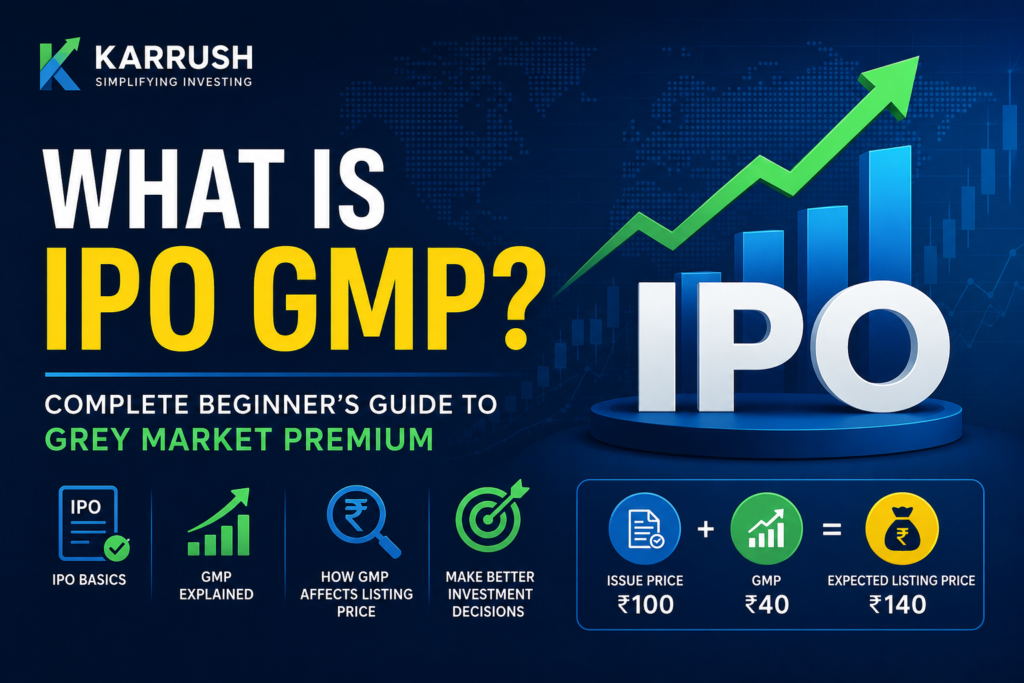
Imagine a company launches its IPO at ₹100 per share. Before listing, some investors in the grey market are willing to pay ₹140 for those shares. The extra ₹40 is known as the Grey Market Premium (GMP).
This suggests that investors expect strong demand when the stock lists on the exchange.
Example Calculation
| Particulars |
Value |
| IPO Issue Price |
₹100 |
| Grey Market Premium (GMP) |
₹40 |
| Expected Listing Price |
₹140 |
Formula
Expected Listing Price = Issue Price + GMP
In the above example:
₹100 + ₹40 = ₹140
This means investors in the grey market expect the IPO to list around ₹140
Many first-time investors make the mistake of applying for an IPO solely because GMP is high. While GMP can provide useful insights into market sentiment, it should never replace proper analysis of the company’s business, financials, and valuation.
📌 Karrush Insight
A high GMP indicates positive market sentiment, but it does not guarantee listing gains. Investors should always evaluate company fundamentals and valuation before applying for an IPO.
What is the Grey Market?
The Grey Market is an unofficial market where IPO shares are bought and sold before listing.
Unlike NSE or BSE, the Grey Market is:
- Not regulated by SEBI
- Not regulated by stock exchanges
- Operated through dealers and brokers
- Based on trust and informal agreements
The Grey Market starts functioning several days before an IPO opens and continues until listing day.
Many investors and traders use Grey Market activity to estimate market demand for an IPO.
Why is IPO GMP Important?
GMP helps investors understand market sentiment towards an IPO.
A higher GMP generally indicates:
- Strong investor demand
- Positive market expectations
- Potential listing gains
A lower or negative GMP may indicate:
- Weak investor interest
- Concerns about valuation
- Poor listing expectations
Example
| Company |
Issue Price |
GMP |
| Company A |
₹100 |
₹60 |
| Company B |
₹100 |
₹5 |
Company A is receiving significantly stronger interest compared to Company B.
How Does IPO GMP Work?
Suppose an IPO is offered at ₹500 per share.
Investors believe the stock could list at ₹650.
As a result, buyers in the Grey Market may be willing to pay a premium of ₹150.
Example
| Issue Price |
₹500 |
| GMP |
₹150 |
| Estimated Listing Price |
₹650 |
The premium reflects investor expectations and market demand.
As market sentiment changes daily, GMP can rise or fall before listing.
How is GMP Calculated?
The calculation is simple.
Formula
GMP = Grey Market Price – IPO Issue Price
Example
| Issue Price |
₹250 |
| Grey Market Price |
₹310 |
| GMP |
₹60 |
Thus:
₹310 − ₹250 = ₹60
What is Estimated Listing Gain?
Many investors use GMP to estimate potential listing gains.
Formula
Estimated Gain (%) = GMP ÷ Issue Price × 100
Example
Estimated Gain:
(20 ÷ 100) × 100
= 20%
Therefore, investors expect around 20% listing gains.
Positive GMP vs Negative GMP
Positive GMP
When GMP is above zero.
Example
| Particulars |
Value |
| Issue Price |
₹200 |
| GMP |
₹50 |
| Expected Listing Price |
₹250 |
Expected listing:
Calculation:
₹200 + ₹50 = ₹250
A positive GMP indicates that investors expect the IPO to list above its issue price. This generally reflects strong demand and positive market sentiment.
Negative GMP
When GMP is below zero.
Example
| Particulars |
Value |
| Issue Price |
₹200 |
| GMP |
-₹20 |
| Expected Listing Price |
₹180 |
Expected listing:
Calculation:
₹200 – ₹20 = ₹180
A negative GMP indicates that investors expect the IPO to list below its issue price. This usually reflects weak demand, valuation concerns, or negative market sentiment.
What is Kostak Rate?
Along with GMP, investors often hear about the Kostak Rate.
Kostak Rate is the premium paid for an IPO application before allotment.
Example
An investor agrees to sell their IPO application for ₹1,000.
Whether allotment happens or not, they receive the agreed amount.
This amount is called the Kostak Rate.
What is Subject to Sauda?
Subject to Sauda is another Grey Market term.
It refers to the premium agreed upon for a confirmed IPO allotment.
Payment is made only if shares are allotted.
Example
If allotment happens:
Buyer pays ₹5,000.
If allotment does not happen:
No payment.
Factors That Influence IPO GMP
Several factors affect GMP.
1. Company Fundamentals
Strong companies usually attract higher GMP.
Investors evaluate:
- Revenue growth
- Profitability
- Business model
- Competitive position
2. Market Conditions
Bull markets generally result in higher GMPs.
Bear markets often reduce investor enthusiasm.
3. Subscription Numbers
Heavy oversubscription usually pushes GMP higher.
Example
| Investor Category |
Subscription |
| Retail Investors (RII) |
40x |
| Non-Institutional Investors (NII/HNI) |
120x |
| Qualified Institutional Buyers (QIB) |
80x |
What does 40x, 120x and 80x mean?
Suppose:
- Retail quota has 1 lakh shares available.
- Retail investors apply for 40 lakh shares.
Then: 40 lakh ÷ 1 lakh = 40x subscription
So Retail becomes 40x subscribed.
Similarly:
- NII category applied 120 times the shares available.
- QIB category applied 80 times the shares available.
In this example, demand for the IPO is significantly higher than the number of shares available. The Retail category is subscribed 40 times, the NII category 120 times, and the QIB category 80 times.
Such strong subscription numbers indicate high investor interest and often support a higher Grey Market Premium (GMP). However, subscription and GMP should be viewed together rather than in isolation.
Such strong demand often supports higher GMP.
📌 Karrush Insight
When both subscription numbers and GMP are strong, it generally indicates positive investor sentiment. However, investors should still evaluate the company’s fundamentals and valuation before making an investment decision.
4. Sector Sentiment
Companies belonging to popular sectors may attract stronger premiums.
Examples:
- Banking
- Technology
- Capital Markets
- Renewable Energy
5. Valuation
Reasonable pricing usually improves investor interest.
Expensive valuations may suppress GMP.
📌 Karrush Insight
GMP can change significantly during the IPO period. A rising GMP often reflects improving investor sentiment, while a falling GMP may indicate weakening demand.
Advantages of Tracking IPO GMP
Quick Sentiment Indicator
GMP provides an early indication of market demand.
Helps Estimate Listing Gains
Investors can estimate potential listing performance.
Useful for Short-Term Traders
Listing gain investors frequently monitor GMP movements.
Daily Market Feedback
GMP changes daily based on investor expectations.
Limitations of IPO GMP
Many beginners make the mistake of relying only on GMP.
This can be dangerous.
📌 Karrush Insight
Some IPOs have listed below GMP expectations, while others have exceeded them. GMP should be treated as a sentiment indicator rather than a guaranteed prediction of listing performance.
Not Regulated
Grey Market transactions are unofficial.
No regulatory oversight exists.
Not Always Accurate
High GMP does not guarantee strong listing gains.
Low GMP does not guarantee poor listing.
Can Change Quickly
A GMP of ₹100 today may become ₹40 tomorrow.
Small Market Size
Grey Market activity involves limited participants.
Therefore, prices may not always reflect actual demand.
Should Investors Apply Based Only on GMP?
The answer is No.
GMP should be used only as a supporting indicator.
Before applying for an IPO, investors should also analyze:
- Company fundamentals
- Financial performance
- Industry outlook
- Valuation
- Risks
- Use of IPO proceeds
- Promoter background
A strong company with moderate GMP may be a better investment than a weak company with a very high GMP.
GMP vs IPO Subscription
| Feature |
GMP (Grey Market Premium) |
IPO Subscription |
| Indicates Investor Sentiment |
Yes |
Yes |
| Official Exchange Data |
No |
Yes |
| Regulated & Transparent |
No |
Yes |
| Changes Daily |
Yes |
Limited |
| Reliability |
Moderate |
High |
What Does This Mean?
GMP
- Unofficial grey market indicator.
- Reflects investor excitement before listing.
- Changes frequently based on demand.
- Useful but not always accurate.
IPO Subscription
- Official data published during the IPO.
- Shows actual investor demand.
- More reliable than GMP.
- Used by serious investors along with company fundamentals.
For example
Imagine an IPO has:
| Indicator |
Value |
| GMP |
₹120 |
| Retail Subscription |
35x |
| NII Subscription |
110x |
| QIB Subscription |
75x |
This combination suggests strong investor interest because both GMP and subscription numbers are high.
Many successful investors check three things together:
- GMP
- Subscription Data
- Company Fundamentals
If all three are strong, the IPO may deserve closer attention. Looking at only GMP can sometimes lead to wrong conclusions.
Common Mistakes Investors Make
Following GMP Blindly
Many investors apply simply because GMP is high.
This approach can be risky.
Ignoring Fundamentals
Strong businesses matter more than temporary premiums.
Assuming GMP Guarantees Profit
Listing prices can differ significantly from GMP expectations.
Ignoring Market Conditions
Broader market sentiment can impact listing performance.
How Should Investors Use GMP?
A balanced approach works best.
Step 1
Study company fundamentals.
Step 2
Review IPO valuation.
Step 3
Check subscription data.
Step 4
Track GMP trends.
Step 5
Make an informed decision.
Using all factors together improves decision quality.
Frequently Asked Questions (FAQs)
What is IPO GMP?
IPO GMP is the premium at which IPO shares trade in the unofficial Grey Market before listing.
Is GMP legal?
Grey Market transactions are unofficial and operate outside stock exchanges. They are not regulated by SEBI.
Does high GMP guarantee listing gains?
No. GMP only reflects market sentiment and does not guarantee listing performance.
Can GMP become negative?
Yes. Negative GMP indicates weak investor demand and lower listing expectations.
Where can investors check IPO GMP?
Many financial websites and IPO tracking portals publish daily GMP updates.
Which is more important: GMP or fundamentals?
Fundamentals are more important for long-term investing. GMP should only be used as an additional indicator.
Final Thoughts
IPO GMP is one of the most widely followed indicators in the Indian IPO market because it provides an early glimpse into investor sentiment before listing.
However, GMP should never be treated as a guarantee of profits. Some IPOs with high GMPs have disappointed investors, while others with moderate GMPs have delivered excellent long-term returns.
Smart investors use GMP as one piece of the puzzle alongside company fundamentals, valuation, subscription data, and market conditions.
If used wisely, GMP can help investors understand market expectations and make more informed IPO investment decisions.
Disclaimer: IPO GMP data represents unofficial market activity and should be used only for informational purposes. Investors should conduct their own research before making any investment decisions.